Generative AI for Lightweighting and Cost Reduction of Washing Machine Parts
Generative AI that explores lightweight, high-stiffness designs for washing machine structural components under strict performance targets
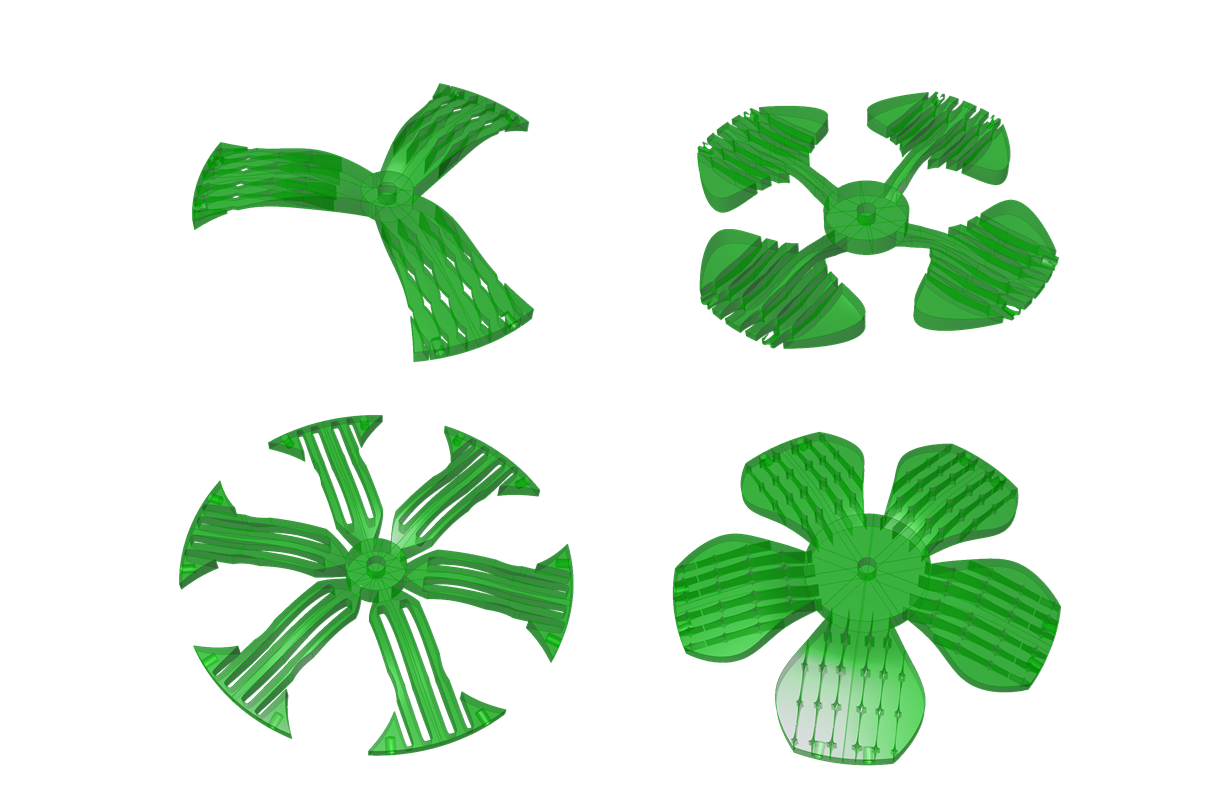
Project Overview
Developed a generative AI workflow to lightweight and cost-reduce structural components in large washing machines while preserving their performance targets. From a small set of core geometric criteria, the system produces a large variety of candidate designs and automatically evaluates their structural response, enabling exploration of the safety-vs-cost trade-off far beyond what a human engineer can realistically try.
My Role
AI Researcher, Narnia Labs
- Individual contributor on the implementation code for the parametric-design and structural-verification pipeline
- Built and tuned the generation–evaluation loop that surfaces the mass-vs-stiffness trade-off
The Challenge
Reducing part cost while preserving structural performance is constrained by both data and process limits:
- Data-limited design exploration: Innovative structural changes are desirable for cost reduction, but limited reference data restricts how broadly the initial design space can be explored.
- Cost vs. durability trade-off: Large-drum washing machines subject parts to high rotational and dynamic loads. Reducing part weight and cost while retaining safety margins is a challenging multi-objective problem.
Technical Approach
Delivered an intelligent design–verify pipeline for structural components:
- Auto-generation from a minimal seed: Given core geometric criteria for a part, the system combinatorially generates a large number of candidate designs, breaking free from the initial data limitation.
- Automated structural verification: Instead of engineers running individual analyses, the system evaluates each candidate’s structural response — vibration, load-bearing — automatically.
- Intelligent optimization (roadmap): A next step is to close the loop with an AI that inverts the evaluation results into a proposed “minimum weight, maximum stiffness” design.
Impact
- Unbounded structural-design exploration: Frees the search from the limits of legacy data and human intuition, systematically covering a much broader design space.
- Cost-quality trade-off surfaced explicitly: Automatically analyzed candidates reveal the optimal frontier that reduces mass (cost) while retaining strength (quality).
- R&D efficiency through pipeline automation: Replaces manual test cycles with an automated pipeline, accelerating early-stage decisions and demonstrating tangible cost-reduction potential.
Client: Electronics manufacturer (undisclosed) Organization: Narnia Labs Category: Electronics
Source: Narnia Labs Case Study #48