Generative AI for Optimal Duct Design in Seat HVAC Systems
Generative AI combined with a physics-based surrogate model for pressure-drop-optimal duct design in seat ventilation
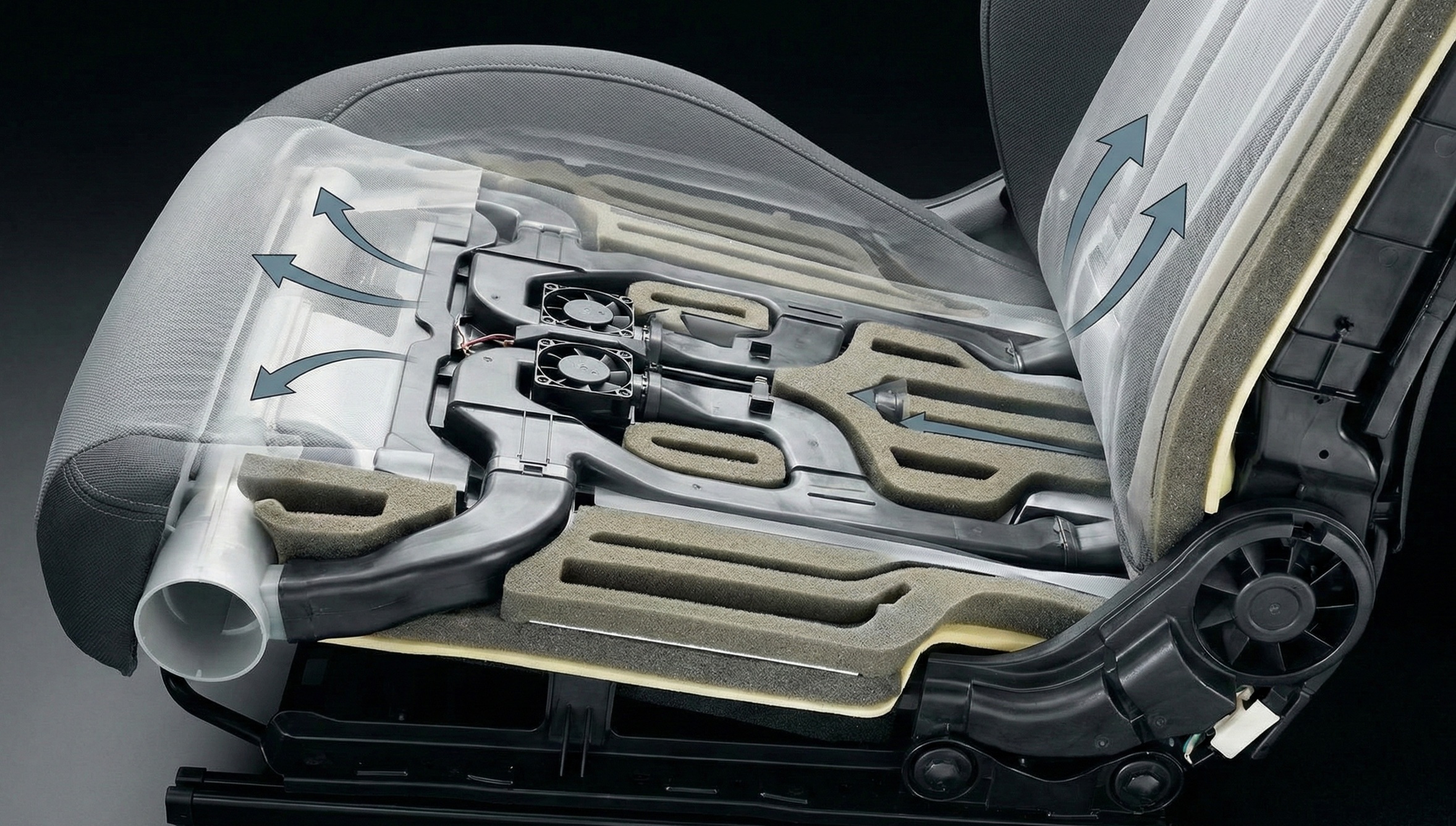
Project Overview
Developed an end-to-end AI platform for designing seat ventilation ducts in mobility applications. Given target boundary conditions, a generative model proposes candidate duct geometries and a predictive surrogate estimates the pressure drop of each candidate in real time. A latent-space optimization loop then converges to a pressure-drop-optimal shape without running conventional CFD.
My Role
Project Manager, Narnia Labs
- Led problem definition and scoping in collaboration with the client team
- Owned client-facing communication and delivery milestones throughout the engagement
- Drove hands-on technical work on the generative + predictive AI platform for pressure-drop-optimal duct design
The Challenge
Traditional seat-vent duct design leans heavily on individual engineer experience, which limits both novelty and rigor:
- Experience-dependent, limited creativity: Designs are dominated by the engineer’s own repertoire, making it hard to reach truly novel duct topologies.
- Limited search methodology: Conventional performance analysis provides little help in systematically exploring hole patterns or flow-channel shapes for optimality.
- Slow evaluation loop: There is no fast way to evaluate many candidate shapes against diverse operating conditions.
Technical Approach
Integrated three components into a single design platform:
- Conditional generative model: Takes design region and operating constraints as input and produces candidate 3D duct geometries.
- Physics-informed surrogate: Predicts the pressure drop of a given 3D duct directly, replacing expensive CFD. The loss embeds airflow physics so predictions remain physically consistent.
- Latent-space optimization: Searches the generator’s latent space to converge on a duct shape that minimizes pressure loss under given constraints.
- Designer-facing GUI: Packaged the whole workflow so that non-specialists can use it without CAE expertise.
Impact
- Radical cut in simulation cost: Real-time pressure-drop prediction replaces expensive CFD runs, collapsing turnaround from days to seconds.
- Broader design exploration: The workflow evaluates a large candidate space quickly, letting designers reach shapes they would not have proposed by hand.
- Design know-how as digital asset: Continuous data updates turn individual engineering intuition into a reusable, company-owned digital asset.
Client: Automotive OEM and Tier-1 supplier (undisclosed) Organization: Narnia Labs Category: Automobile
Source: Narnia Labs Case Study #63